“PURIFYING LOVE”
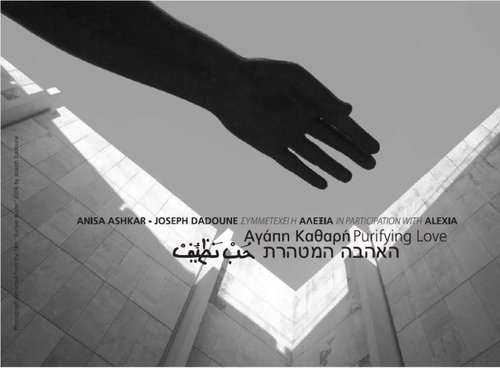
“PURIFYING LOVE”
JOSEPH DADOUNE - ANISA ASHKAR
Curated by the art theorist Dr. Sania Papa*
Track7 arts laboratorium organizes and presents the artistic exhibition of Anisa Ashkar (1979, Palestine) and Joseph Dadoune (1975, Israel) with the general title “Purifying Love” at track7 art space.
The project consists of an original production by Track 7 for Greece and abroad. The exhibition will open to the public on Monday 15 January 2007.
The exhibition includes two autonomous original projects that are presented for the first time worldwide in Athens. In the specific projects of the two artists, the well known Cypriot singer Alexia collaborates and participates multi-dimensionally (composition, singing, and acting). The exhibition is curated by the art theorist Dr. Sania Papa.
Anisa Ashkar and Joseph Dadoune were invited in 2005 to an artistic residence, in the context of the Annual Festival Action Field Kodra, in the former camp of the Macedonian Fighter Kodra (a collaboration of FORUM European Cultural Exchanges and the Municipality of Kalamaria of Thessaloniki) with the theme “Borderlines.” Joseph Dadoune and Anisa Ashkar invited Alexia to collaborate on multiple levels in their two new autonomous works, aiming at the creative collaboration between three artists coming from countries with similar sociopolitical characteristics, traditions and cultural qualities.
Approaching afresh this thematic axis, the artists create innovative works implying the abolishing of borderlines (geographic, political, racial, class, religious, cultural). The abolition of borderlines in art is linked directly with one of its basic intrinsic permanent characteristics, that is the transcendence of reality, in favor of a poetic and cross-cultural interpretation of the world. In this new mobile residence the three artists worked on the spot through repeated moves, for four months in Athens.
In this mobile space of free outlook and departure, Joseph Dadoune, Anisa Ashkar, artists who belong to diverse levels of “normality” and universality, come to present their unique identities in a historically charged space-time, since the invitation to Athens meant a new point of departure and action, a new creative challenge.
Joseph Dadoune, through a "laborious" and long-lasting creative process of the treatment of film (change of color from colored to black and white, chronological shift of actions, interruption of linear narration, expulsion of concrete elements of natural architectural space, and utilization of special effects), presents the analytic conceptual dimension of created cinematographic reality (the film is based on the interjection of the three basic colors white, black, and red): the liberating nature of the natural and intellectual light against the terror of repetitive confinement that intervenes redemptively in a space-time without beginning or end (the viewer may watch the film without a time sequence).
The multidimensional work of Joseph Dadoune connects different expressive and conceptual media (photography, drawing, performance, cinematographic films, video and production of vinyl records), approaching the complicated nature of identity (individual, collective, political, cultural, social and artistic) the meaning of the revelation of time management, of the sacred, and of spirituality in contemporary culture, of the inexpressible, of the chthonic and of the supernatural. A self-taught artist with many years of apprenticeship in theology makes an absolutely personnel work with direct or concealed references to the tradition of Judaism and to the continuous conflict between East and West.
According to Yoav Shmueli “The presence that Joseph Dadoune creates is as deep, theosophical, mystical, secretive and artistic as it can be. Perhaps, a postmodern version of dispute, one that shocks the foundation, a deep bow of respect and a powerful gesture to Michelangelo and Caravaggio. Dadoune spent his childhood as a pious student of the order “Eder” of the religious school Yeshiva, in Ofakim, a poor but interesting town in the 80s. An only child of an old mother who felt remorse and decided to emigrate with her son from France to Israel. Later, Dadoune will begin his wandering and will be refined as an artist. Today, he wanders and creates works of art between Ofakim, Tel Aviv, Nice, Paris and Miami.”
His recent film work “SION” (Jerusalem 2006) was presented at the Louvre Museum and was purchased for the collection of the Museum’s department of Contemporary Art.
According to Talya Halkin “The work of Anisa Ashkar has as point of departure body art and performance, which appeared in the limelight at the end of the 60s and the beginning of the 70s, where the artists rebelled against the traditional conventions of exhibition practice in museums and galleries, attempting to eliminate the limits between art and life. Particularly for women artists, the metamorphosis of their bodies to object and simultaneously subject of their art took the form of an aesthetic action and political freedom.”
For Anisa Ashkar the use of body, of language (written and oral), and of writing, make up the basic axes of her work. “When I write on my own body I feel free to do what I want,” says Anisa Ashkar. “There is no censorship apart from the one that I impose on myself and I am a good censor. My work has to do with women more generally but also more specifically with the women from Arabia. My political identity is directly connected with my identity as a woman. The only thing that I want to represent is myself, Anisa, avoiding all kinds of generalizations.”
In her new work (installation and performance) titled “Wild Eyes,” Anisa Ashkar studies, treats on many levels and reinterprets the myth of Perseus and Medusa, placing it in a contemporary context of conflict and contradictions.
She treats here the ambiguity of the myth and the “eternal” conflict of gender through a psychological and psychoanalytical interpretation, in favor of exposing the suspended moment of decapitation.
According to the artist, this myth, that was written by men, is redefined through the prevalent role of two women (Medusa and Athina), while the man (Perseus) is exposed as “object” who receives commands and executes them, without questioning his male power and identity, since this is repositioned in the context that suits it. In the performances of Anisa Ashkar, Alexia “assumes” the role of Athina and transforming the roles is presented as ally of mutilated Medusa.
The verses and prose of Alexia from her new triple CD titled rebe, that will soon be released, are translated in Arabic and work as linguistic, experiential fragments, as speech crosses different properties of languages (Greek, English, Cypriot, Spanish) and are “transferred” from one tradition to another.
Alexia records: “This, and with a hand holds her neck, ‘it is not separate from this’ and holds her heart. Nor from this, and she points to the temple, meaning the mind, the spirit. My voice, to agree to come out and be heard, should speak or sing, for all that it saw and passed, to speak also to others, to communicate, to understand and to be understood. Instead of the voice accepting, remaining a speechless witness, obediently accepting its silence, any type of suppression that especially a woman endures, so that with the realization to stop these from happening, instead of speaking about her real issues and indeed to speak, with words that will have been chosen herself, because she has the right and because she can, instead of this, she is called to sing for the next table, implying the table of the night club where she saw, by chance his/her lover, sometimes former, sometimes present, with somebody else.
Therefore the betrayal, certain. No trust thus neither in the self nor in others. And this non-music that is manufactured cannot for me be classified as anything that is a source of live, or life giving. Something, that would lead to the repair of the relationship with the self. To help the dialogue to begin.”
The deep spiritual and emotional relationship of Anisa Ashkar with Greek history is encountered in her early adolescent years. The creation of an original work with the subject an ancient Greek myth was a life dream for her. Here she is given the opportunity to present the personal version of the myth, as the choice of the subject is by no means accidental.
The outcome is not possible to be predicted ahead of time. Through the process of the formative action of daily dialogue, of recording and of submission of personal life experiences of the three artists, events emerge, variations of facts or even the unforeseen, capable of linking the desirable aesthetic proposals. The limits/borders as indicators of the end and of the beginning eliminate the borderline of restriction and diversity, reinforcing the significance of heterogeneous identity, the passage between the here and the hereafter, the inside and the outside, the non-time place of narratives and the specific place of interstice with the past, in favor of the regained time of timeliness.
posted by SJD at 5:09 AM


<< Home